
Key takeaways
- Burnout and disengagement cost employers an estimated $322 billion a year in turnover and lost productivity, according to Gallup.
- A corporate wellness retreat removes the phones, meetings, and noise that keep stressed teams from recovering.
- Deloitte UK found employers get nearly 4.70 pounds back for every 1 pound spent supporting employee mental health.
- A structured fasting and detox retreat pairs guided recovery with measurable before-and-after health markers.
- Treat a retreat as an investment with tracked outcomes: engagement, sick days, and retention over the following quarter.
A corporate wellness retreat works because it does one thing an office never can: it fully disconnects the team from the source of their stress. When people are comparing providers for a team detox retreat, the real question is whether a few days away actually changes how a team performs when they return. The evidence on burnout says it can, provided the retreat is structured for recovery rather than entertainment.
Most leaders already feel the problem. Staff are present but flat, meetings drag, and good people quietly start looking elsewhere. The numbers behind that feeling are large, and so is the opportunity to reverse it.
Why a corporate wellness retreat targets the real cost of burnout
Burnout is expensive long before anyone resigns, and a corporate wellness retreat is one of the few interventions that addresses the cause instead of the symptom. Gallup estimates that employee burnout and disengagement cost employers roughly $322 billion a year in turnover and lost productivity (Gallup, 2024). That figure captures what a stressed, checked-out workforce drains from a business every quarter.
The human signals are just as telling. The same Gallup research found that burned-out employees are 63% more likely to take a sick day and 74% more likely to be looking for another job. Each absence and each departure carries a cost in cover, recruitment, and the slow erosion of knowledge that walks out the door with every experienced hire.
Chronic stress does not stay contained to one person. It spreads through a team as shortened tempers, slower decisions, and a general reluctance to take on anything extra. By the time it shows up in a resignation letter, the damage to focus and morale has usually been running for months.
Many wellness perks miss this entirely. A gym membership or a meditation app sits unused by the people who need it most, because the problem is not a lack of tools. The problem is that the working environment never lets anyone stop. A retreat changes the environment itself, which is why it reaches people that in-office benefits cannot.
How structured retreats restore focus and morale
A structured retreat restores focus by breaking the stress loop that daily work keeps alive. Gallup found that only 20% of employees worldwide are engaged at work, and 40% said they experienced a lot of stress the previous day (Gallup, 2025). People in that state cannot concentrate their way out of exhaustion while sitting at the same desk.
Removing the triggers is the point. No notifications, no back-to-back calls, no late-night inbox. When the nervous system finally stops bracing for the next interruption, sleep deepens and attention returns. That recovery shows up physically in rested faces and steadier energy, well beyond a passing lift in mood.
Morale follows the same path. A team that rests together, eats together, and reflects together rebuilds trust that pressure had worn thin. People come back with a shared reference point and a clearer sense of why the work matters. That is harder to manufacture inside the office that caused the burnout in the first place.
There is also a quieter benefit. When leaders join the same retreat as their team, the usual hierarchy relaxes for a few days. Honest conversations surface that would never happen in a boardroom, and those conversations often outlast the retreat itself. A team detox retreat gives that candor a place to happen without the risk of looking weak in front of the people you manage.
What a corporate fasting program includes
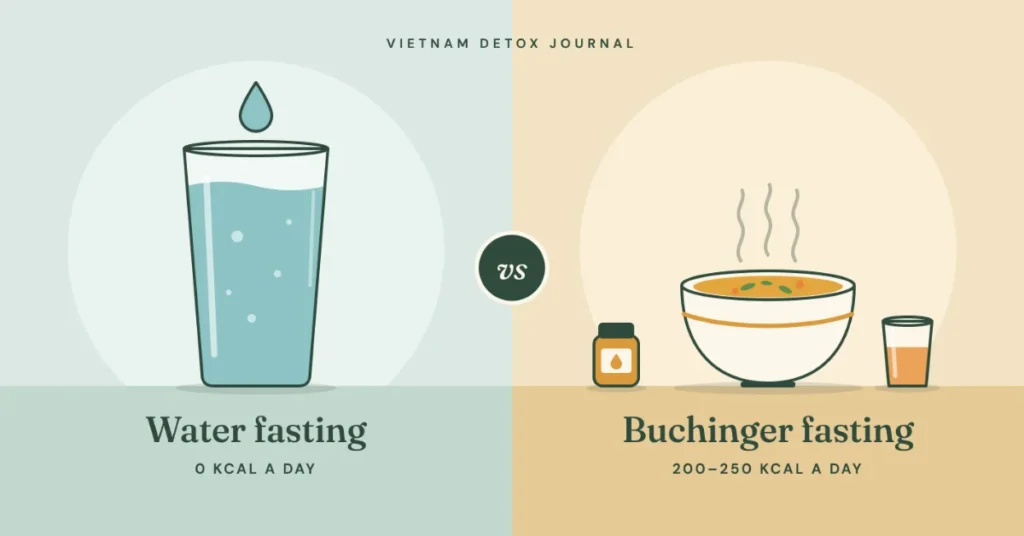
A corporate fasting program is a supervised recovery process, not a crash diet. The Buchinger method that Vietnam Detox uses pairs medically guided fasting with rest, gentle movement, and traditional Vietnamese healing practices. The structure matters more than the setting, because a team needs to feel safe enough to actually let go.
A well-run program typically includes:
- A medical intake and screening before arrival, so anyone who should not fast is identified early.
- A staged plan: preparation days, the fasting window, and careful refeeding at the end.
- Daily monitoring of each participant by qualified staff.
- Guided movement, rest, and reflection built around the body's reduced energy during fasting.
- A clear digital boundary that keeps work communication out for the duration.
The combination of German fasting science and Vietnamese practice gives the program a dual purpose. Participants get a measurable physical reset, and they get the mental space that unplugging provides. For a team, that shared discipline also becomes the glue that casual offsites rarely create.

Measuring ROI on employee recovery
The return on employee recovery is measurable, and the ratio can be strong. Deloitte UK found that for every 1 pound spent supporting employee mental health, employers get nearly 4.70 pounds back on that investment (Deloitte, 2024). The same analysis put the cost of poor mental health to UK employers at 51 billion pounds a year.
To see the return from a specific retreat, track a short list of honest metrics before and after. Self-reported stress and energy give an immediate read. Engagement survey scores, sick days, and voluntary turnover over the following quarter give the business read. Compare those against the retreat cost per person, and the picture is usually clear.
There is a simpler check as well. Managers notice within weeks whether a recovered team is making faster decisions, volunteering for work, and arguing less. Those behaviors are what the $322 billion in burnout cost looks like when it finally moves in the right direction.
One caution on the numbers. A single retreat will not fix a culture that creates burnout the moment people return. The strongest results come when a retreat is paired with real changes at the office: protected focus time, fewer pointless meetings, and managers who model rest rather than punish it. The retreat resets the team; the follow-through keeps the reset from fading.
Planning logistics for group bookings
Good logistics protect the recovery you are paying for, so plan the group booking early. For a team of eight or more, two to three months of lead time covers medical intake, travel, and reserving private group dates. That window also lets each participant clear their calendar properly, which is what makes the digital boundary hold.
Work through these decisions before you confirm:
- Group size and whether you want the retreat private to your team or shared.
- Fasting readiness, since intake will flag anyone who should follow a modified plan.
- Travel and visas for international locations, booked against the retreat dates.
- A coverage plan at the office so nobody feels pressured to check in.
- The before-and-after metrics you will collect, agreed with HR in advance.
Private group bookings give a leadership team or department the room to be honest with each other without an audience. For corporate groups, Vietnam Detox runs structured Buchinger-method retreats designed for exactly this, combining the fasting science with the rest a depleted team needs.
The next step is simple. Pick the quarter you can afford to send a team away, set the two or three recovery metrics you care about, and open an intake conversation with a provider whose program is built around supervision rather than scenery. A team that comes back rested, aligned, and genuinely unplugged pays that decision back fast.
Frequently asked questions
What is a corporate wellness retreat?
It is a planned off-site program where a team steps away from work to focus on physical and mental recovery through structured activities such as fasting, movement, rest, and guided reflection. The goal is measurable recovery, not a holiday.
How is a team detox retreat different from a team-building trip?
A team-building trip adds activity and social time. A team detox retreat subtracts: it removes screens, alcohol, overeating, and constant stimulation so the nervous system can reset. The focus is recovery first, bonding second.
Is a corporate fasting program safe for a whole team?
A supervised Buchinger-method program includes medical screening, daily monitoring, and staged refeeding. Participants with certain conditions are advised against fasting during intake, which is why qualified supervision matters.
How do we measure the return on a wellness retreat?
Track a few honest metrics before and after: self-reported stress and energy, engagement survey scores, sick days, and voluntary turnover over the next quarter. Compare against the retreat cost per person.
How far in advance should we book a group retreat?
For groups of eight or more, plan two to three months ahead. That window covers medical intake, travel, room blocking, and the lead time most retreat centers need to reserve private group dates.