
Key takeaways
- Exercise while fasting works best when it stays gentle: slow walks, stretching and restorative yoga, not high-intensity training.
- Walking around 9,000 to 10,000 steps a day was linked to a 39% lower mortality risk in a 2024 study of over 72,000 people.
- Yoga shows a moderate, measurable effect on perceived stress, making it well suited to the lower-energy days of a fast.
- Your body's signals, not a plan or a step goal, decide how much to move on any given fasting day.
- Gentle movement supports lymphatic flow, steadier mood and nervous-system regulation without adding physical stress.
Gentle movement is the kind of exercise that fits a fast: slow walks, light stretching and restorative yoga, done at an easy pace. Hard training works against the quiet, restorative state a fast is meant to create, so most people feel better moving less and listening more. This guide explains how exercise while fasting actually works, why intensity backfires, and how simple walking and yoga support your mood, your recovery and your body's natural detox processes.
Fasting already asks a lot of your body. It shifts how you make energy, lowers your fuel stores and invites your nervous system to settle. Movement during this time should support that shift, not fight it. The goal is to feel lighter and clearer, not depleted.
Why Intense Exercise While Fasting Is Counterproductive
Hard training during a fast tends to add stress rather than support recovery. When you stop eating, your body gradually uses up its stored carbohydrate (glycogen) and leans more on fat for fuel. High-intensity exercise depends heavily on those quick-access carbohydrate stores, so once they run low, intense effort feels harder and recovers slower.
There is also a hormonal cost. Demanding workouts raise cortisol, the body's main stress hormone. A fast is a time to let the nervous system calm down, so piling on physical stress can leave you wired, tired and sore. For generally healthy people doing a preventive reset, that is the opposite of the point.
Intense exercise while fasting can also sharpen hunger, disturb sleep and make the day feel like a grind. Beneath the surface, a fast sets off cellular housekeeping that gentler days help protect, which is another reason to keep effort low.
None of this means you should lie still. It means you choose movement that works with your lower fuel state, not against it.
The Benefits of Slow Walking and Stretching
Slow walking is one of the most underrated forms of exercise while fasting, and the evidence for walking in general is strong. In a 2024 study of 72,174 people published in the British Journal of Sports Medicine, walking roughly 9,000 to 10,000 steps a day was linked with a 39% lower risk of death and a 21% lower risk of cardiovascular disease, even among people who sat for long hours (BMJ Group, 2024).
On a fasting day, you do not need to chase that number. The point of the research is simpler: easy, regular walking is genuinely good for you, and it asks very little of your fuel stores. A slow walk keeps blood moving, supports digestion as it rests, and gives the mind somewhere calm to settle.
Gentle stretching adds its own quiet benefits. It eases the stiffness that can come with slower days, keeps joints comfortable, and signals to the body that it is safe to relax. A few unhurried stretches in the morning or before sleep can be enough.
What makes both practices suit a fast is their restraint. They are:
- Low in fuel demand, so they rarely leave you drained
- Easy to scale down on tired days and up on brighter ones
- Calming for the nervous system rather than stimulating
- Simple to continue at home long after a retreat ends
Walking in nature deepens the effect. Many guests find that an unhurried morning walk among trees does more for their head than any workout, which is why it anchors so many of our quieter days.
Simple Yoga Sequences for Low-Energy Days
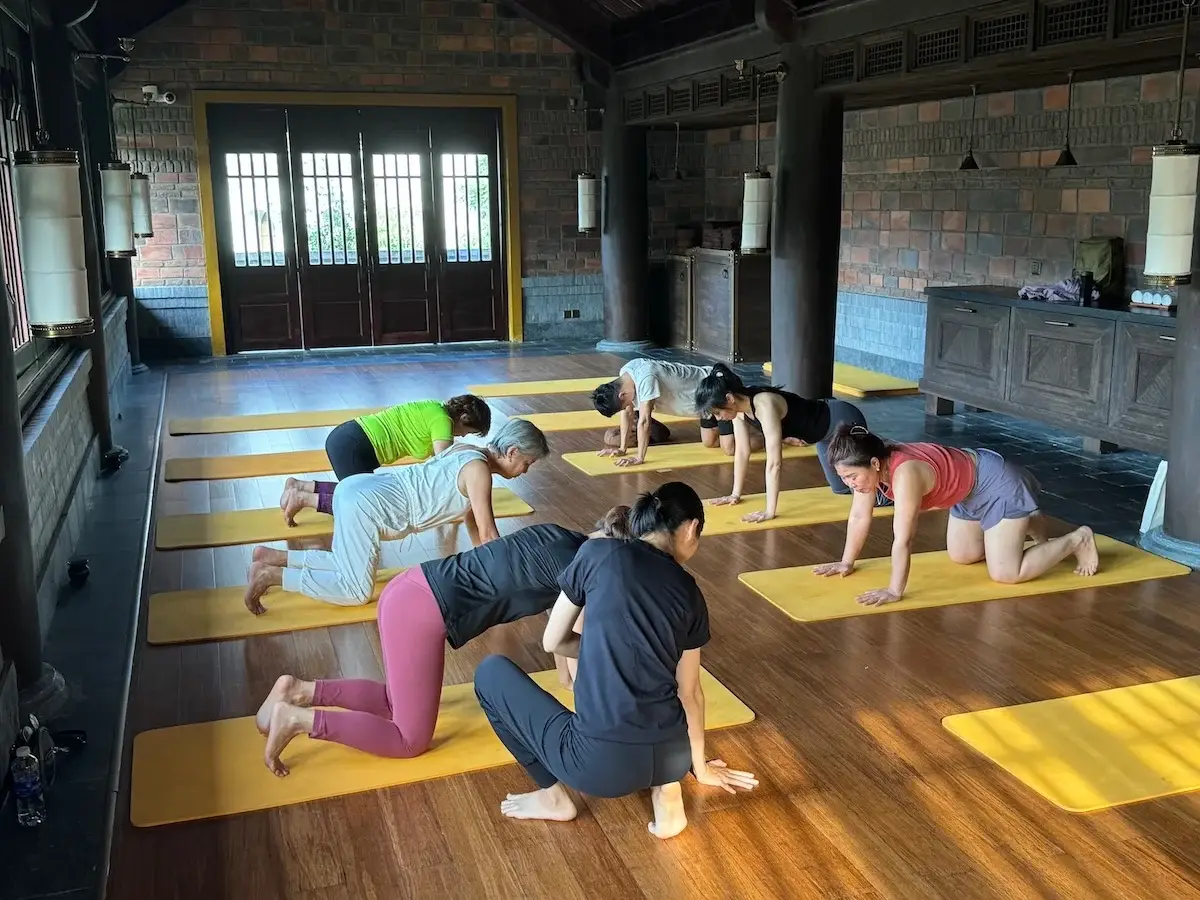
Gentle yoga suits fasting because it calms the mind and body without demanding much fuel. A 2024 meta-analysis of 36 studies in Health Psychology Review found that yoga had a moderate effect on reducing perceived stress, with a standardised effect size of Hedges' g = 0.48 (PubMed, 2024). On the lower-energy days of a fast, that calming quality matters more than any physical challenge.
The key is to choose slow, restorative styles over fast, heated or strength-based ones. Think long, supported holds and steady breathing rather than flowing sequences that build a sweat. A simple low-energy sequence might look like this:
- A few minutes of seated breathing, letting the exhale lengthen
- Gentle neck and shoulder rolls to release held tension
- A slow seated forward fold, only as far as feels easy
- A supported twist on each side, breathing into the stretch
- Legs resting up against a wall for a few quiet minutes
- A final rest lying down, letting the body settle completely
Move slowly between poses and skip anything that strains. If a pose feels like effort, it is probably too much for a fasting day. The aim is release, not achievement.
Breathwork belongs here too. Slow, even breathing nudges the nervous system toward its rest-and-recover mode, which pairs naturally with the deeper rest a fast encourages. If better sleep is part of your goal, our piece on fasting and sleep explains how the two reinforce each other.
Listening to Your Body's Signals
The most important rule of gentle movement fasting is this: your body decides, not your plan. Energy levels vary from day to day and even hour to hour during a fast. A step goal or a yoga routine is only a starting point. What you actually do should follow how you feel.
Some signals are a clear invitation to rest or stop. Pay attention if you notice:
- Dizziness, lightheadedness or feeling faint
- Unusual weakness or heavy, shaky limbs
- A racing heart during very light effort
- Nausea, chills or a cold sweat
- A strong sense that you simply need to lie down
If any of these appear, stop, sit or lie down, and rest. These are not failures. They are your body doing its job, telling you it needs quiet rather than motion.
On the other side, mild tiredness, a slower pace and less appetite for activity are normal and nothing to push through. Some days a ten-minute walk is plenty. Learning to read these signals is one of the quiet skills guests take home, part of what makes the experience about building confidence rather than dependence. At Vietnam Detox, small groups and direct contact with the founders mean movement is always carefully guided and matched to the person, never prescribed by a one-size plan.
How Movement Supports Detox and Mood
Gentle movement supports the body's own detox and mood systems without adding stress. Your lymphatic system, the network that clears waste and supports immunity, has no pump of its own. It relies on muscle movement and breathing to keep fluid flowing, so even slow walking and easy stretching help it do its work. This is one reason a fast and gentle movement pair so well: the body is clearing house, and light motion keeps things moving.
Mood benefits are just as real. Easy walking, especially outdoors, tends to lift spirits and quiet mental noise, and yoga's measurable effect on stress carries straight into how a fasting day feels. Movement also supports nervous-system regulation, helping the body shift out of a tense, alert state and into one where repair and rest can happen.
There is a mental shift too. When movement stops being about burning calories or hitting targets, it becomes something gentler: a way to check in with yourself. Many people arrive at a reset carrying the strain of overwork, and a slower relationship with movement is part of the recovery.
The combination of fasting, nourishing food, mindful movement, deep rest and genuine connection is the foundation of the Vietnam Detox approach. Gentle movement is one thread in that larger weave, and on its own it is a practice almost anyone can carry home.
A Calm Way Forward
If you are planning a fast, treat movement as part of your rest, not a separate task to complete. Start with a single slow walk and a few minutes of easy stretching, see how your body responds, and let that guide the next day. Keep it light, keep it kind, and stop when you need to. That simple habit, practised gently and consistently, is often the piece people are most glad they kept long after the fast has ended.
Frequently asked questions
Is it safe to exercise while fasting?
For generally healthy people, gentle movement during a fast is usually well tolerated. Keep it light: slow walking, stretching and easy yoga. Avoid intense or heavy training, and stop if you feel dizzy, weak or unwell.
Can I do yoga on a fasting day?
Yes. Slow, restorative yoga suits fasting well because it calms the nervous system without demanding much fuel. Favour gentle stretches, breathwork and floor poses over fast, heated or strength-focused styles, and rest whenever you need to.
How much should I walk while fasting?
There is no fixed number. Many people feel good with one or two unhurried walks a day. Let energy and comfort guide the distance rather than a step target, and treat walking as rest for the mind as much as movement for the body.
Why does intense exercise feel so hard when fasting?
During a fast your body shifts toward burning fat for fuel and glycogen stores run lower. High-intensity work relies heavily on those fast-access carbohydrate stores, so it can feel unusually hard and raise stress hormones rather than support recovery.