
Key takeaways
- Chronic stress keeps cortisol high, which is linked to atrophy in hippocampal subfields that handle memory and mood regulation.
- A 2025 meta-analysis of 71 studies found no meaningful cognitive gap between fasted and fed healthy adults, so fasting does not dull a healthy brain.
- Fasts of 12 hours or less showed no cognitive decline, while slight dips appeared only past 12 hours in the same analysis.
- During ketosis, beta-hydroxybutyrate rose 249% over 12 weeks in one trial, giving the brain a steady alternative fuel many people describe as clearer.
- Rest and time in nature lower the stress load fasting is trying to interrupt, so recovery matters as much as the fast itself.
A stressed brain runs on a chemistry of alarm: high cortisol, a worn-down hippocampus, and a prefrontal cortex that struggles to stay in charge. Fasting and brain health intersect here, because stepping away from constant eating and constant input gives that system a rare pause and a different fuel to run on. This article walks through what chronic stress does to the brain, what fasting actually changes, the role ketones play, the emotional shifts people describe, and why rest and nature finish the job.
What Chronic Stress Does to Brain Chemistry
Chronic stress keeps cortisol elevated, and sustained high cortisol has been linked to shrinkage in parts of the hippocampus, the brain region most exposed to this hormone. These are the areas that handle memory and help regulate mood, so wearing them down has real daily costs.
The pattern is familiar to anyone who has been pushed too hard for too long. Thoughts loop. Sleep thins out. Small decisions feel heavy. Cortisol is useful in short bursts, but when it never switches off, it shifts the brain into a defensive crouch that is hard to leave on willpower alone.
The prefrontal cortex takes the hit too. This is the part of the brain that plans, weighs options, and holds impulses in check. Under sustained stress, it loses ground to older, faster circuits built for threat. That is why a tired, stressed person reacts more and reflects less. The brain is doing exactly what stress chemistry tells it to do, which is to stay on guard.
If you recognize that state in yourself, it may already be more than ordinary tiredness. Learning to tell burnout apart from everyday fatigue is the first step toward a reset that actually holds. The point of a fast, in this context, is to break the loop long enough for the slower, wiser parts of the brain to come back online.
Fasting and Brain Health: Focus and Mood
Fasting does not appear to dull a healthy brain. A 2025 meta-analysis of 71 studies, covering 3,484 participants and 222 cognitive measures, found no meaningful difference in performance between fasted and fed adults on attention, memory, and executive tasks (University of Auckland, 2025). The old worry that skipping meals wrecks your thinking does not hold up.
Duration matters, though. The same analysis found no cognitive cost from fasts of 12 hours or less, with only slight dips appearing once a fast ran longer than 12 hours. That is a useful line to know before pushing into a multi-day fast without guidance.
Mood tells a similar story. In controlled trials of time-restricted eating, participants have generally reported stable mood even while sometimes feeling less focused in the morning hours. The felt experience and the measured one do not always match, which is worth remembering when you read glowing testimonials.
So where does the famous focus come from? Part of it is the removal of distraction. A day without meals to plan, buy, cook, and clean up after is a day with fewer interruptions. Part of it is steadier energy once the body stops riding blood sugar swings. The brain is not suddenly faster. It has fewer things pulling at it, and that can feel like a real upgrade in attention.
The Role of Ketones in Mental Clarity
Ketones are the quiet engine behind much of the fasting mental clarity people describe. When food is scarce, the liver converts fat into ketone bodies, and the main one, beta-hydroxybutyrate, crosses into the brain as fuel. One trial measured a 249% rise in this ketone over 12 weeks of nutritional ketosis (Brain Sciences, 2022), placing participants firmly in the therapeutic range.
Why does that feel like clarity? A brain running partly on ketones gets a steady supply instead of the sugar spikes and crashes that come with constant snacking. Researchers are still mapping how this links to brain-derived neurotrophic factor, a protein tied to learning and the growth of new neural connections. Human fasting studies have not shown reliable BDNF jumps from fasting alone, so the mechanism is promising rather than proven.
Keep a sense of proportion here. The fuel switch is measurable and the subjective calm is common, but neither means a fast rebuilds your brain overnight. What a fast reliably does is change the conditions the brain works under: fewer glucose swings, a quieter gut, and a break from the constant drip of food decisions. For most people, that is the mechanism behind the clear-headed feeling, not a dramatic surge of growth factors.
Emotional Shifts People Report During a Fast
The emotional arc of a fast is usually the part people remember most. The first day or two can bring irritability and restlessness as the body adjusts and old habits lose their grip. After that, many report a flatter, calmer baseline, a sense that the usual mental noise has dropped a few notches.
Some of this is physiological, tied to the fuel shift above and the break from blood sugar swings. Some of it is behavioral. Removing the constant decision of what and when to eat frees up attention, and that alone can feel like relief. The structure of a fast does part of the emotional work, which is one reason a supervised approach tends to feel steadier than going it alone.
People also describe a kind of emotional honesty during a fast. With the usual comforts of food set aside, feelings that were being eaten over tend to surface. That can be uncomfortable on day one and clarifying by day three. Having guidance through that stretch matters, because the goal is to meet those feelings with rest rather than push through them.
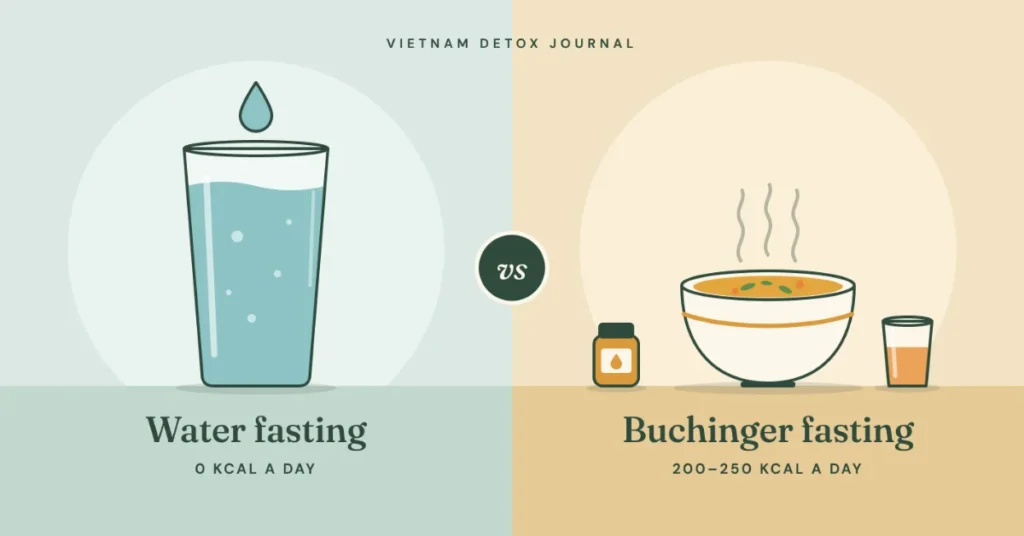
The difference between methods matters here. Our comparison of water fasting versus Buchinger fasting explains why the gentler, broth-and-juice approach is easier on mood than a strict water fast. For a brain already low on reserves, a method that supplies a little energy and support is the kinder path through the hard early days.
Supporting Recovery With Rest and Nature
A fast interrupts the stress cycle, but rest and nature are what let the brain actually settle. Chronic stress is sustained by poor sleep, packed schedules, and screens, so a fast done inside the same frantic environment loses much of its point. Pulling back from those inputs is as important as the fast itself.

This is where a structured retreat earns its place. At Vietnamdetox, the Buchinger method is paired with quiet, slow days and time outdoors, so the fast and the environment pull in the same direction. The aim is to give a tired nervous system the conditions it needs to downshift: light food in the right moments, real sleep, walking, and stillness. Enduring hunger on willpower alone is never the point.
Nature does specific work for a stressed brain. Quiet green surroundings lower arousal, slow breathing, and pull attention outward instead of inward toward the same anxious loops. Add real sleep, and the brain gets the overnight maintenance that chronic stress tends to steal. These are not luxuries layered on top of the fast. They are part of how the reset actually takes hold.
Think of the fast as the interruption and the setting as the recovery. One without the other does half the work. A brain that has been stuck in alarm needs both the chemical pause and the calm around it to find a steadier rhythm again.
If a stressed, foggy brain is the problem you are trying to solve, start smaller than you think. Try a gentle 12-hour overnight fast for a week, protect your sleep, and take one daily walk outdoors without your phone. If you want to go deeper, do it under supervision rather than alone. A structured retreat like the one Vietnamdetox runs exists for exactly that: the fast, the rest, and the quiet surroundings working together so the recovery lasts beyond the week you spend on it.
Frequently asked questions
Is fasting good for brain health?
For healthy adults, fasting does not appear to harm cognition. A 2025 meta-analysis of 71 studies found no meaningful difference between fasted and fed people on attention, memory, and executive tasks. Short fasts under 12 hours showed no decline at all.
Does fasting really improve mental clarity?
Many people report sharper focus during a fast, often once ketones rise. Controlled studies do not show a measurable boost in test scores, so the clarity is partly subjective. It is real to the person feeling it, but do not expect a higher IQ.
What are ketones and why do they matter for the brain?
Ketones are fuel the liver makes from fat when food is scarce. The main one, beta-hydroxybutyrate, crosses into the brain and powers neurons. One trial measured a 249% rise in this ketone over 12 weeks of nutritional ketosis.
How long should I fast to affect my brain?
There is no single number. The 2025 meta-analysis found no cognitive cost up to 12 hours, with only slight dips beyond that. A structured, supervised fast is the safer way to go longer without guesswork.
Can fasting help with stress and mood?
Fasting interrupts routines that feed chronic stress and often brings a calmer, steadier mood after the first couple of days. The effect is strongest when paired with rest and nature, which lower cortisol on their own.