Nutrition Journal
Two people sit down to the same Vietnamese lunch. One starts with the rice, the other with the greens and the soup. An hour later, their blood sugar tells two very different stories. Here is what the research shows, and how to use it at your own table.
Picture a typical Vietnamese family meal. A bowl of clear soup, a plate of boiled greens, fish braised in a clay pot, some tofu in tomato sauce, and a pot of steaming rice in the middle. It is a wonderfully balanced way of eating: vegetables, herbs, lean protein and a moderate amount of fat, all on one table.
Yet two people can eat exactly this meal and have very different glucose spikes afterwards. The difference is not what they eat, but the order. A growing body of research suggests that eating vegetables first, then protein, and rice last can make the rise in blood sugar after a meal noticeably smaller and gentler.
When you eat carbohydrates such as rice, noodles, bread or sugar, your body breaks them down into glucose, which enters the blood. Blood sugar rises, the pancreas releases insulin, and glucose is moved into your cells. This is completely normal. A “glucose spike” simply means a rise that is large and fast, often followed by a dip.
In everyday life, many people notice those dips as an afternoon slump, sudden hunger or a craving for something sweet. Over the years, frequent large swings may matter more. Glucose that stays high for long periods reacts with proteins in the body and forms so-called advanced glycation end products, or AGEs, which researchers link with stiffer blood vessels and age-related wear. The evidence is strongest in people with diabetes, and our article on advanced glycation end products explains the topic in more detail.
For orientation, a normal fasting blood sugar is below 5.6 mmol/L (100 mg/dL), according to the American Diabetes Association. After a meal, it is normal for the value to rise for a while. The aim is not to avoid every rise, but to make the big peaks smaller and the curve flatter.
Rice is at the heart of Vietnamese food culture, and grains provide about 70 per cent of daily energy in the Vietnamese diet, according to a 2024 analysis of national data. At the same time, studies suggest that people of East and Southeast Asian heritage tend to have a larger glucose response to the same carbohydrate meal than people of European heritage, and may develop diabetes at a lower body weight.
Meanwhile, sugary drinks, sweet coffee and milk tea have become part of office life, from Hà Nội and Hồ Chí Minh City to Singapore, Kuala Lumpur, Manila and Hong Kong. Vietnamese health officials now speak of more than seven million people living with diabetes, many of whom do not know it yet. A small change at every meal can therefore add up.
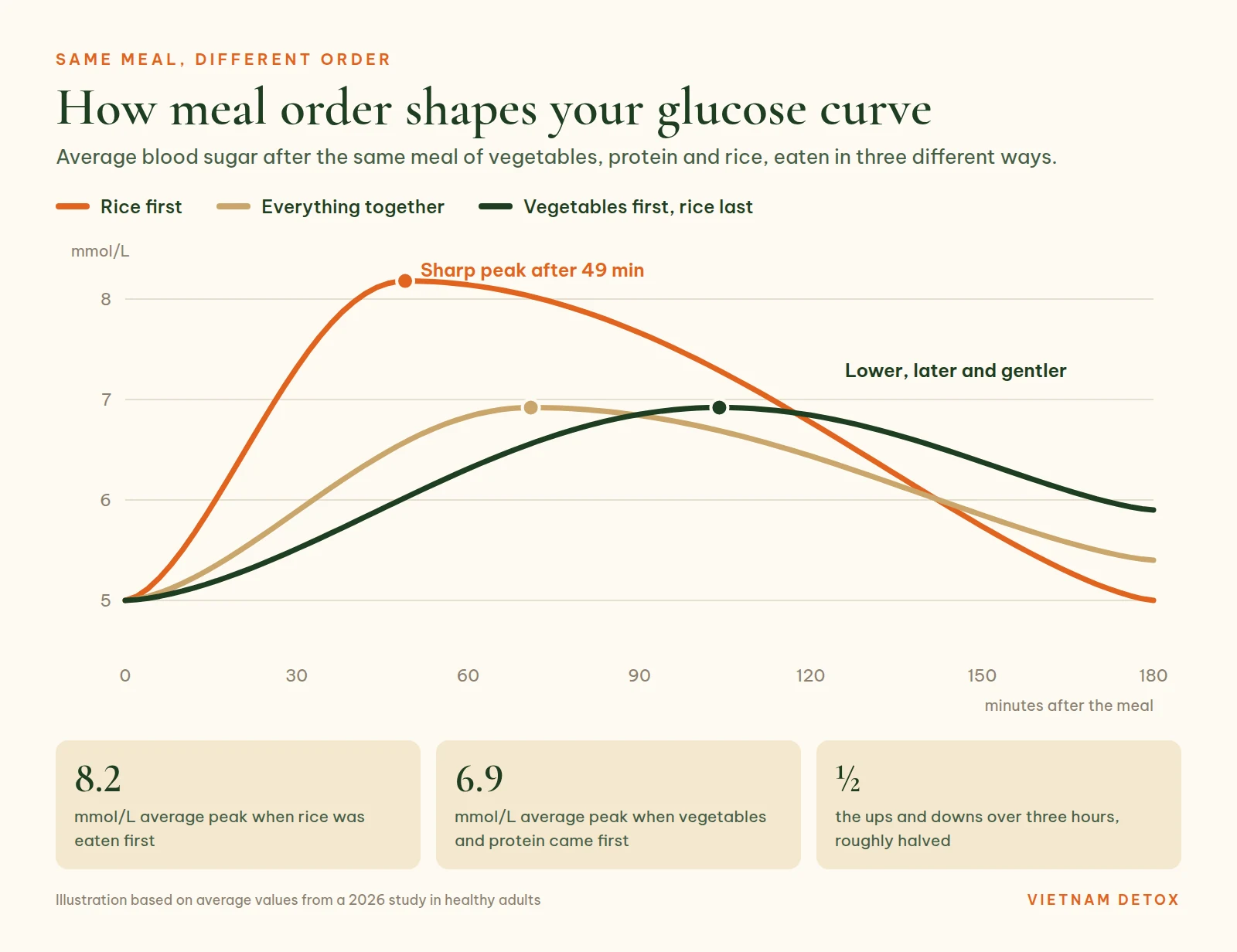
The clearest new evidence comes from Korea. In a 2026 study, 33 healthy young women ate the same meal on four different days, each time in a different order, while a small sensor on the arm recorded their glucose every few minutes.
Journal: Diabetes, Obesity and Metabolism, 2026
Who was studied: 33 healthy Korean women with an average age of 25, wearing continuous glucose monitors, who ate the same 573 kcal meal in four different sequences.
What was found: When they ate vegetables first, then protein, then carbohydrates, the rise in the first hour was about 74 per cent smaller than when carbohydrates came first. Peak glucose was 6.9 mmol/L at around 104 minutes, compared with 8.2 mmol/L at around 49 minutes with carbohydrates first, and the ups and downs over three hours were roughly halved.
Limits: The group was small, young and healthy, and the study looked at single meals, not long-term health. Compared with eating everything together, the peak was similar, but it came later and the curve was gentler.
This is not an isolated finding. Studies from several countries, many of them with rice-based meals, point in the same direction, and a 2026 review of six studies in healthy adults, most of them from Asia, reached a similar conclusion.
Researchers think several things work together. Fibre and protein in the stomach slow down how quickly food passes into the small intestine, so glucose from the rice arrives in the blood more gradually. Protein and fat also prompt the gut to release hormones such as GLP-1, which supports an earlier, smoother insulin response and a sense of fullness.
Rice dishes vary a great deal in how quickly they raise blood sugar. The glycaemic index (GI) compares foods with pure glucose, which scores 100. Values of 55 and below are considered low, 70 and above high. A table compiled by the Nutrition Institute of Hồ Chí Minh City gives a helpful picture of everyday Vietnamese staples.
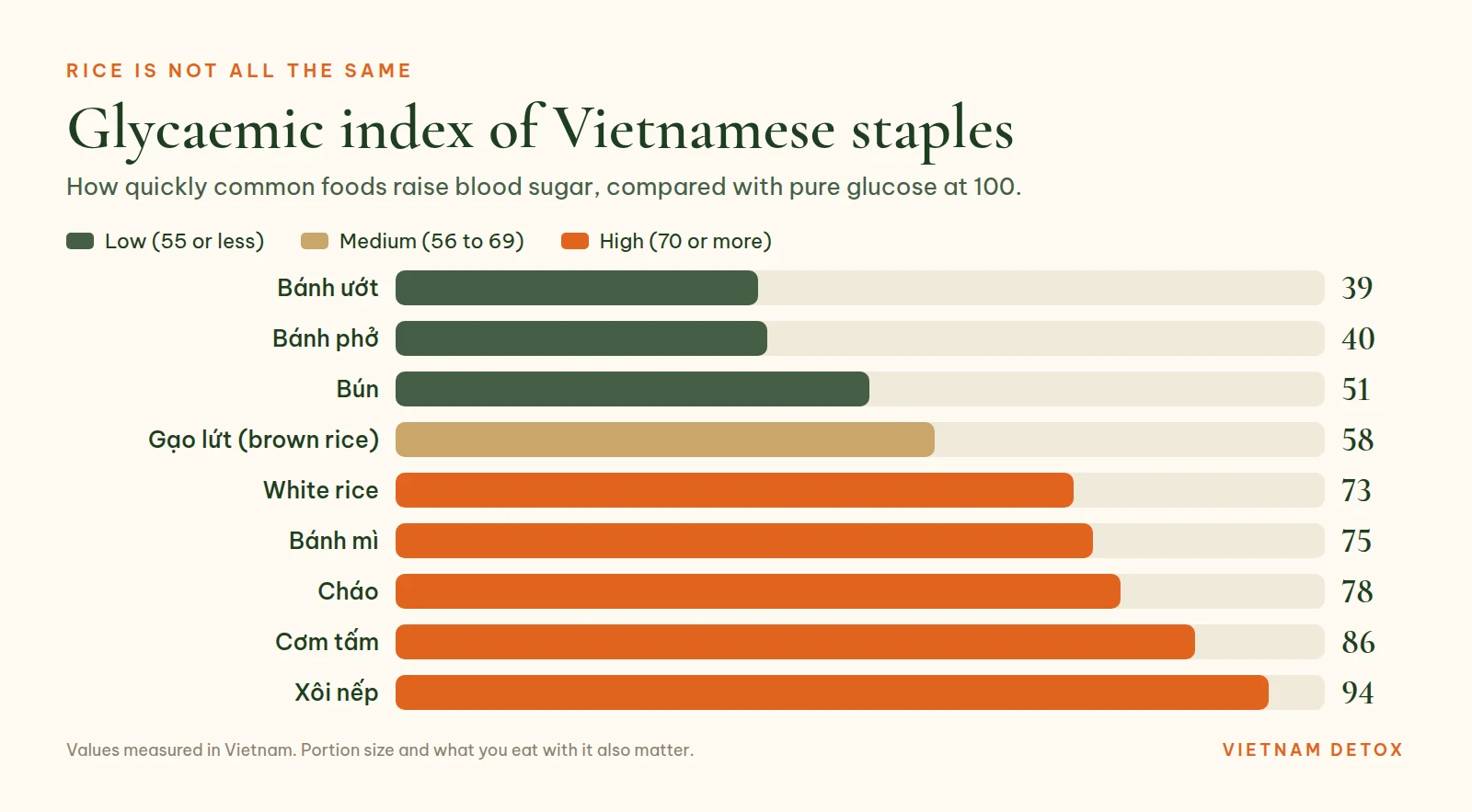
A few things stand out. Sticky rice (xôi) and broken rice (cơm tấm) sit at the top, and long-cooked rice porridge (cháo) is higher than ordinary steamed rice. Fresh rice noodles such as bánh phở and bún are lower, although large portions still add up. Brown rice (gạo lứt) is a gentler choice for every day. GI values are measured on a food eaten alone, so the vegetables, protein and order of your meal change the real effect, which is exactly the point.
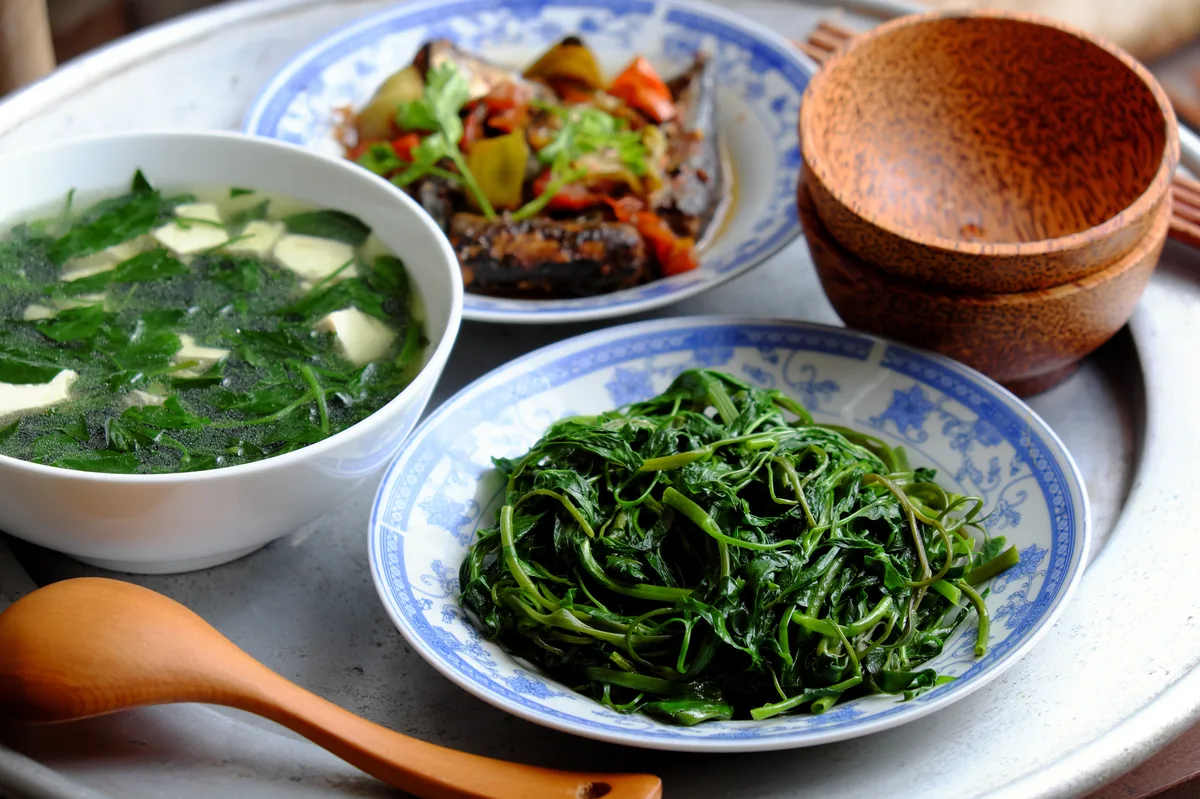
Here is the good news for anyone who enjoys Vietnamese food: you do not need to change what is on the table. A traditional meal already offers everything a steady curve needs: vegetables in many forms (rau luộc, rau sống, herbs), a clear soup (canh), a protein dish (món mặn) and rice. The Japanese and Singapore studies above used meals much like this. The only thing that tends to tip the balance is the habit of filling the bowl with rice first, sometimes with canh poured over it, and eating everything at once.
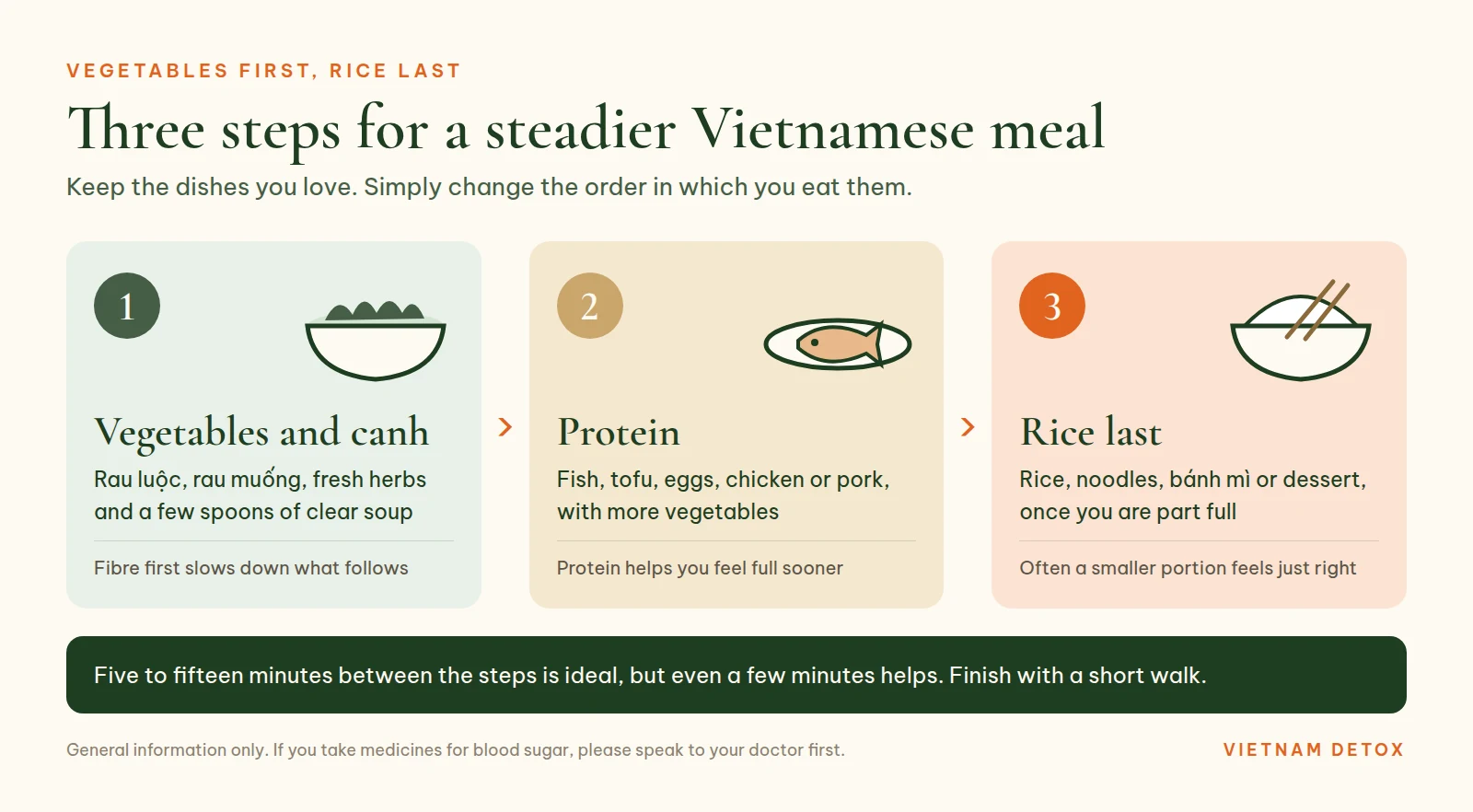
You do not need to wait long between the steps. The Japanese set-meal study used five to fifteen minutes, but even a few minutes of greens and protein first appears to help, so a quick bowl at a street stall still counts.
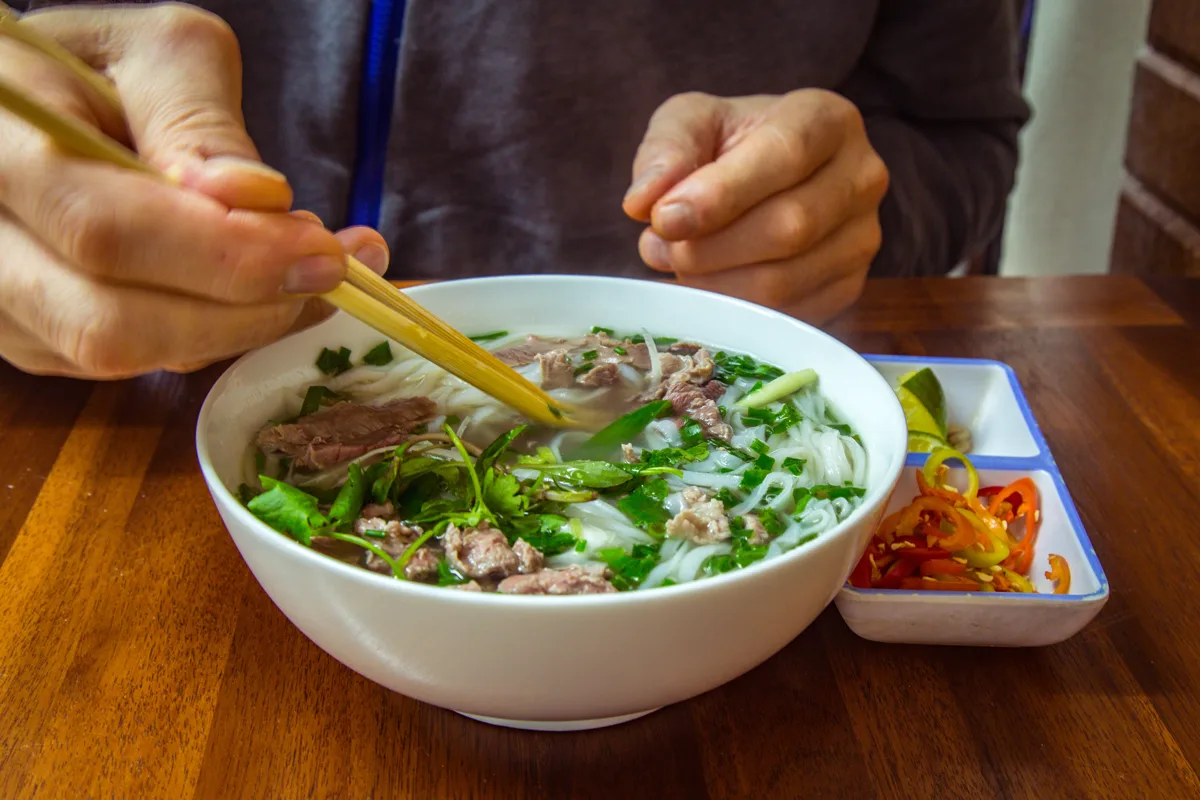
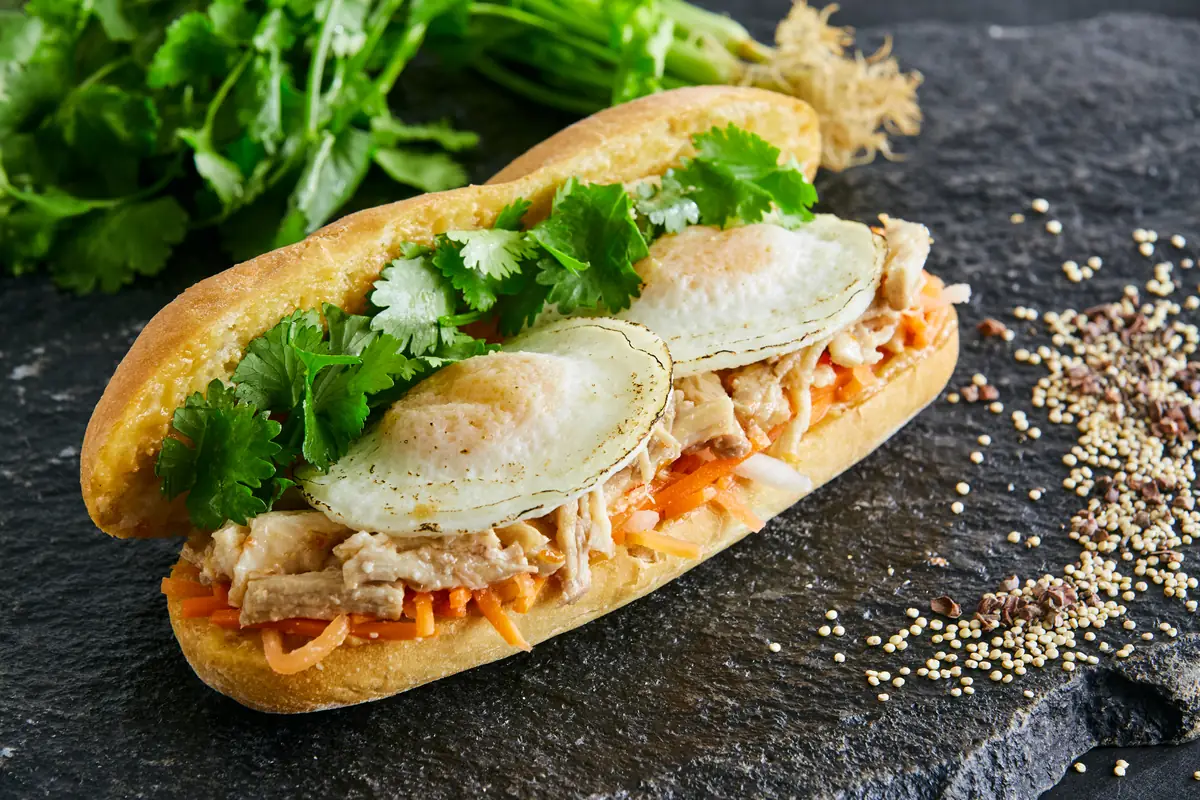
The same idea works for almost any Vietnamese meal, at home or eating out.
Same food, steadier order
| Meal | Usual way | Steadier way |
|---|---|---|
| Cơm gia đình (family meal) | Bowl filled with rice first, canh poured over it | Canh and rau luộc first, then fish or tofu, rice last, perhaps one bowl instead of two |
| Phở bò or phở gà | Noodles first, broth at the end | Add herbs and bean sprouts, sip the broth, eat the meat and greens, noodles last |
| Bánh mì | With a sweet iced coffee on the go | Egg or meat filling with extra cucumber and pickles, coffee afterwards, black or less sweet |
| Cơm tấm sườn | A large plate of broken rice with grilled pork | Cucumber, tomato, pickles and egg first, then the pork, a smaller portion of rice last |
| Bún chả or bún thịt nướng | Noodles straight into the dipping sauce | Fresh herbs, green papaya pickles and grilled pork first, then the noodles |
Breakfast deserves a special mention. A sweet breakfast on an empty stomach tends to cause the biggest rise of the day, so the mostly savoury Vietnamese breakfast is good news. The sweet traps tend to come later: condensed milk in cà phê sữa đá, sweet xôi and the afternoon milk tea.
The French biochemist Jessie Inchauspé shares her own glucose experiments as the Glucose Goddess with more than six million followers on Instagram, and her book Glucose Revolution (2022) brought the idea of glucose spikes to a wide audience. Her central message fits the research above in one sentence:
Two of her experiments use foods that could come straight from a Vietnamese kitchen. In one, she ate rice, tofu and broccoli in two different orders. In the other, she ate shrimp dumplings with a starchy wrapper, first on their own and then after a small starter of radishes with yogurt. Both times, the vegetables first turned a sharp spike into a gentle rise.
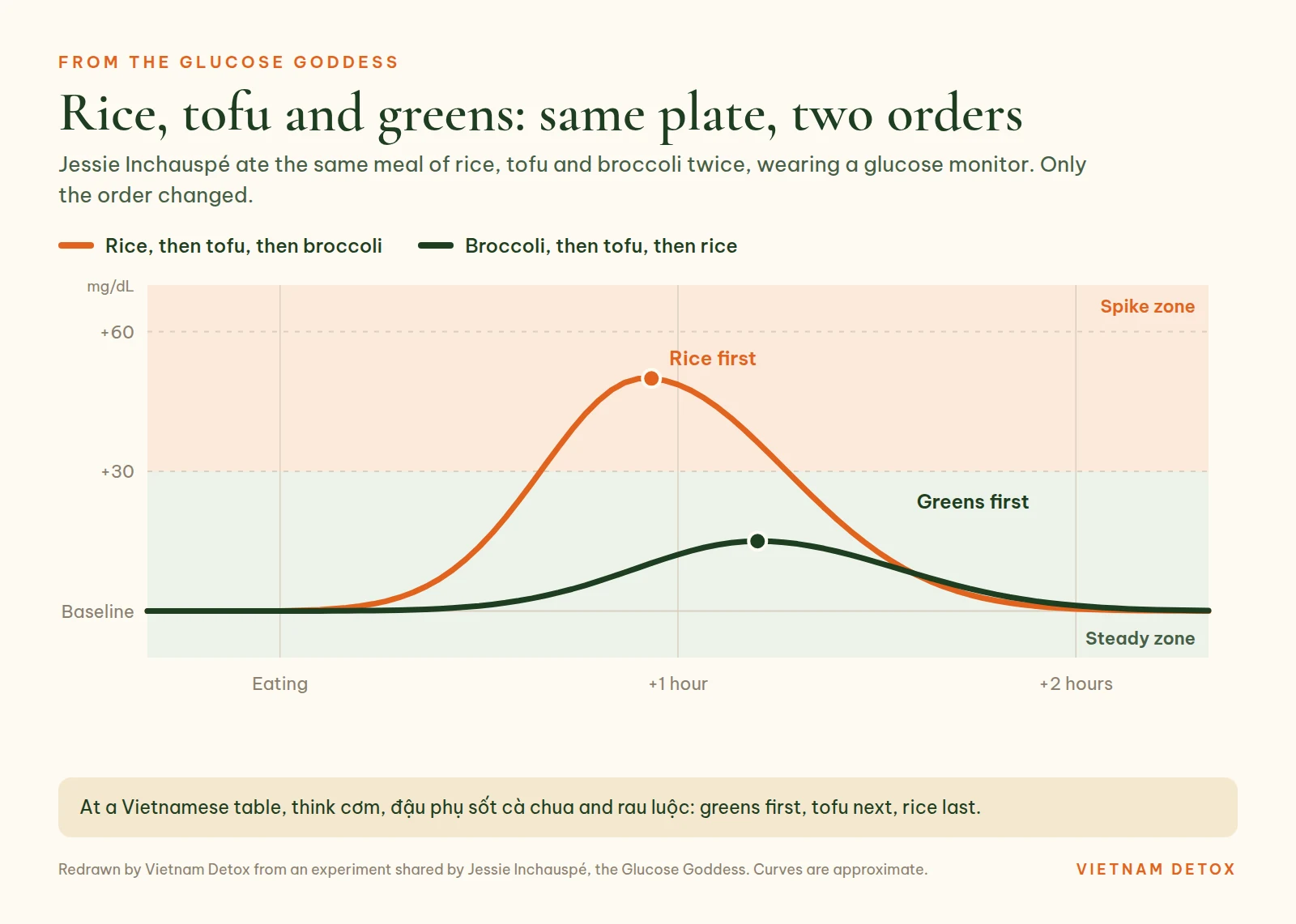
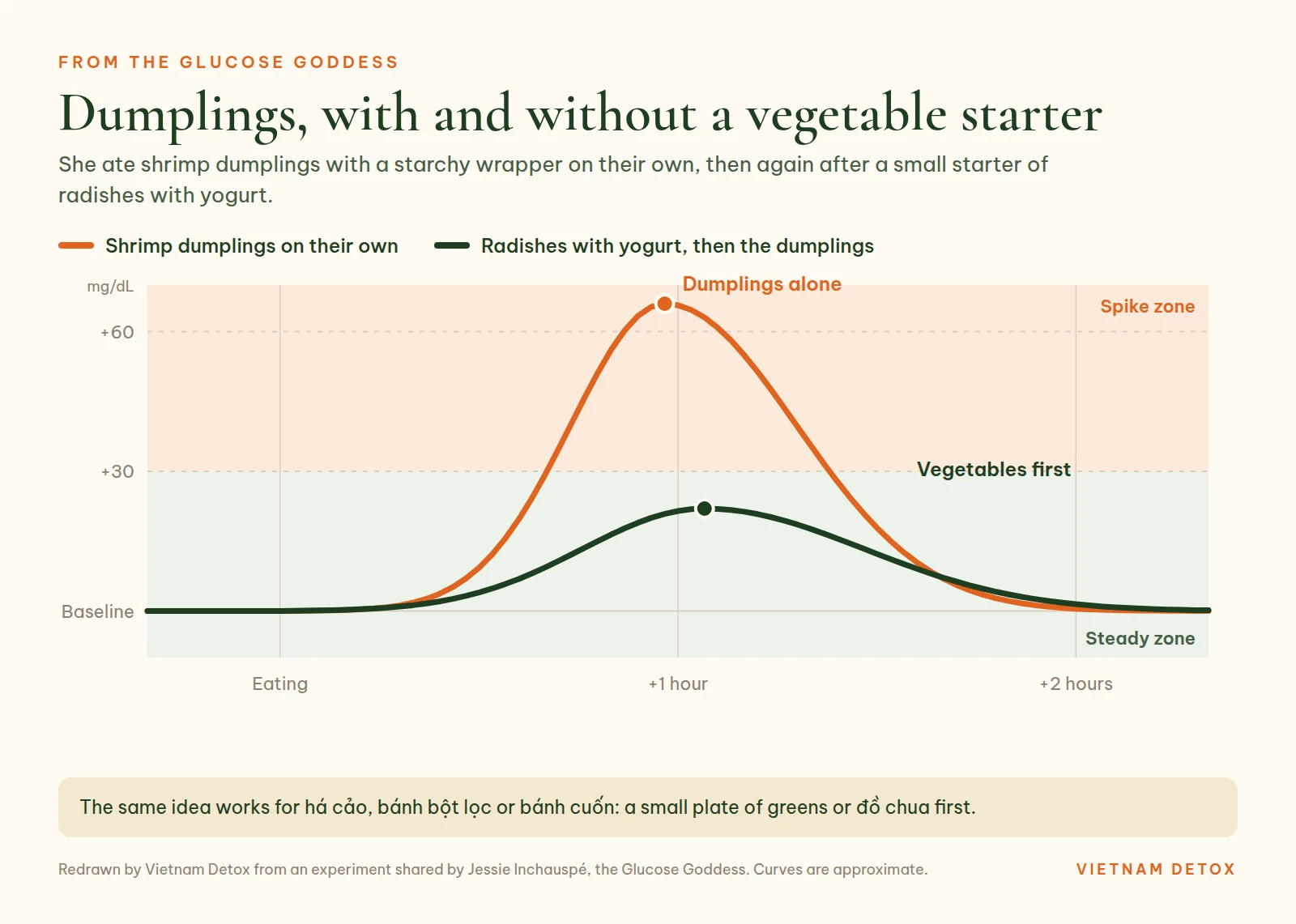
These are single experiments on one person, and she describes them herself as illustrations of published research rather than studies in their own right. Her ten “hacks” put the ideas into everyday habits. Here they are at a Vietnamese table:
Ten glucose hacks at a Vietnamese table
| Her hack | How it can look in Vietnam |
|---|---|
| 1. Eat foods in the right order | Canh and greens first, then fish, tofu, egg or meat, rice last |
| 2. Add a green starter to every meal | A small plate of rau luộc, rau muống or a herb and cucumber salad |
| 3. Stop counting calories | Choose fish, tofu, eggs and vegetables for their fibre and protein, not for a low number (more below) |
| 4. Flatten your breakfast curve | Phở with herbs, eggs or cháo with fish rather than sweet xôi or pastries |
| 5. All sugars are the same | Honey, cane sugar and condensed milk all count |
| 6. Pick dessert over a sweet snack | Chè or fruit straight after a meal (more below) |
| 7. Reach for vinegar before you eat | A few pickles such as dưa góp to start the meal |
| 8. After you eat, move | A short walk around the lake or the lane (more below) |
| 9. If you must snack, go savoury | Peanuts, a boiled egg or cucumber instead of biscuits |
| 10. Put clothes on your carbs | Never eat rice, bread or noodles “naked”: add vegetables, egg, tofu or fish |
Not all of her suggestions have the same strength of evidence. Vinegar before meals, for example, has mostly been studied in small groups, often in people with diabetes, and is best taken diluted or with food. The food-order advice, however, is one of the well-supported parts of her message, and it suits Vietnamese food most naturally.
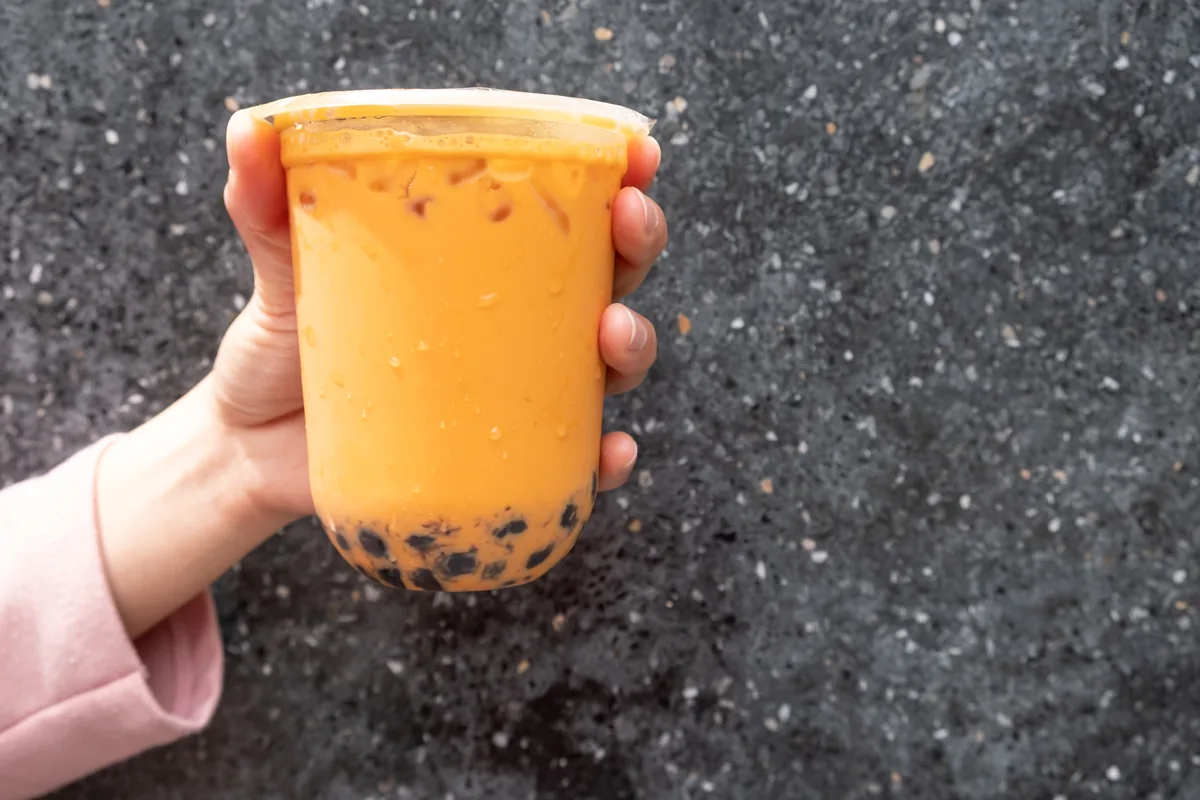
Most of us enjoy something sweet now and then. The research on food order suggests a simple strategy: enjoy it straight after a meal, when vegetables, protein and fat are already in your stomach, rather than on its own at three in the afternoon. Choosing 30 or 50 per cent sugar in milk tea, or swapping it for fresh fruit such as green mango, pomelo or guava, makes a difference too.
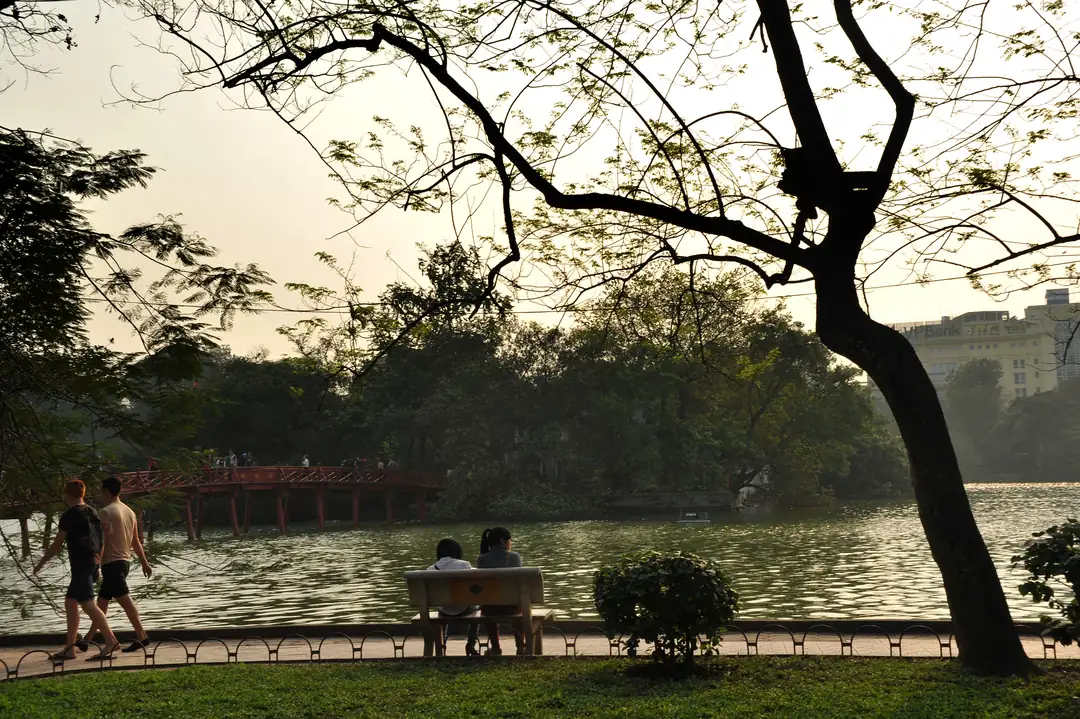
A short walk after a meal is a simple way to soften glucose spikes. A 2022 analysis of several studies found that light walking after eating lowered both glucose and insulin compared with sitting. In a 2025 study in Thailand, a 30-minute light walk after meals lowered glucose over six hours by about 30 per cent in young adults living with obesity.
Many older Vietnamese already know this instinctively. The evening walk around Hoàn Kiếm Lake, a local park or the neighbourhood lane is a familiar sight. Ten to fifteen minutes, ideally within half an hour of eating, is enough to make a difference.
Calories still count, but they are not the whole story. In a well-known 2019 study at the US National Institutes of Health, people ate about 500 kcal more per day on an ultra-processed diet than on an unprocessed one with the same calories, sugar, fat and fibre on offer, and gained 0.9 kg in two weeks.
Food order works in a similar spirit. The same meal produces less insulin and, in several studies, a stronger feeling of fullness, which may make it easier to eat a little less rice and skip the afternoon snack. To be honest, no trial has yet shown that food order alone leads to lasting weight loss, and a 2026 meta-analysis of 18 trials found the benefit clearest in the first hour after eating. So we see it as a helpful daily habit, not a quick fix, best combined with whole foods, movement and good sleep.
Fasting gives the body a pause from constant glucose rises. In a study of 1,422 people who fasted for 4 to 21 days with the Buchinger method, blood glucose fell to the low end of the normal range, and 93.2 per cent reported no feeling of hunger. Early findings also suggest that after a fast, people may find very sweet, salty and fatty foods less appealing, although this research is still preliminary.
This makes the days after a fast a good moment to build new habits.
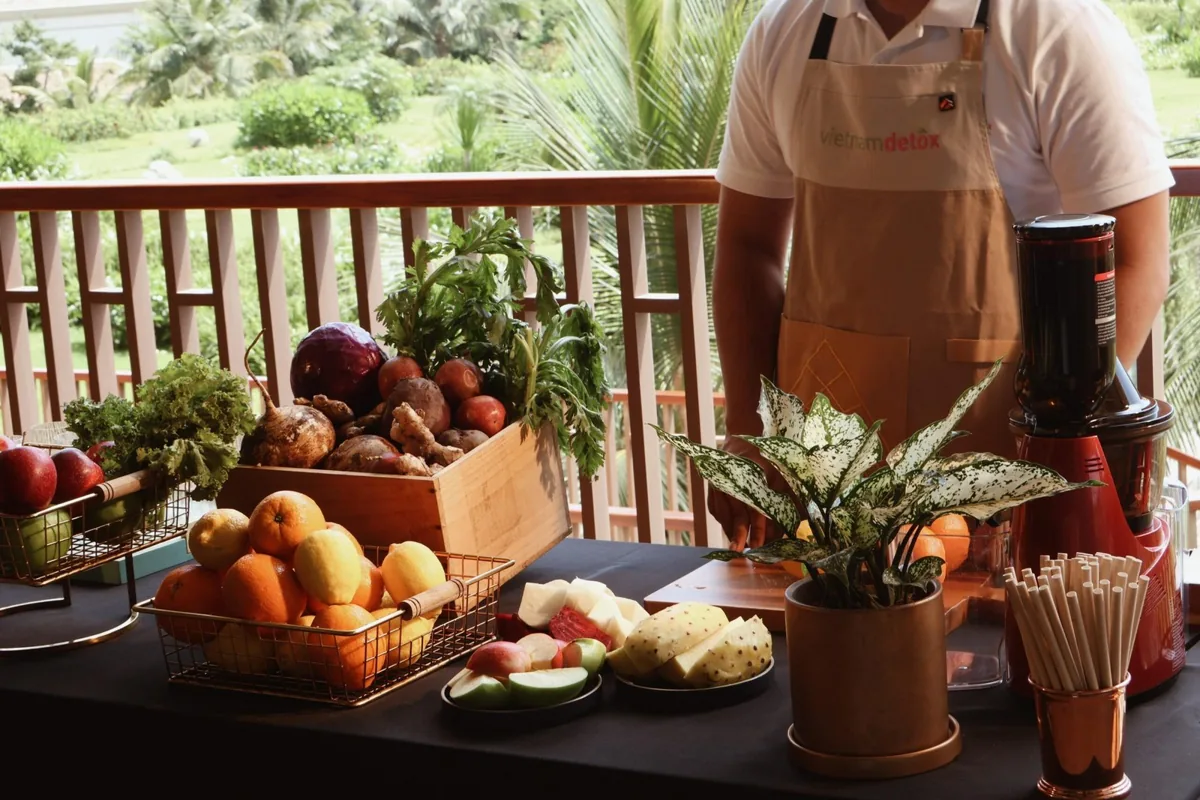
During our building-up days, meals already follow this rhythm. A vegetable juice or warm broth comes 20 to 30 minutes before eating, cooked vegetables open the meal, and protein returns gently from the second day. Rice and other starches return in small portions, and we encourage a short, relaxed walk after meals. It is an order that is easy to keep at home. Our article on the building-up days describes the three days in detail.
Our tip
You do not need a glucose monitor or a new diet. You might try the order for one week at your usual meals: greens and canh first, protein next, rice last, and a short walk afterwards. Then notice how you feel in the afternoon.
Signs worth discussing with a doctor
•Strong thirst, frequent urination or unexplained tiredness or weight loss
•Diabetes in your family, or a waist that has grown over recent years, even if you feel well
•Medicines that lower blood sugar, such as insulin or sulfonylureas, before you change how you eat
•Pregnancy, if you would like to adjust your meals
•If you have never had your blood sugar measured, a simple check during your next health visit
Share this article
Questions about glucose spikes and food order? We would be glad to hear from you. Write to us.
With warm wishes,
Dieter and the Vietnam Detox team
Next step
Our preventive wellness retreats combine Buchinger fasting, careful building-up days, daily walks and time in nature.
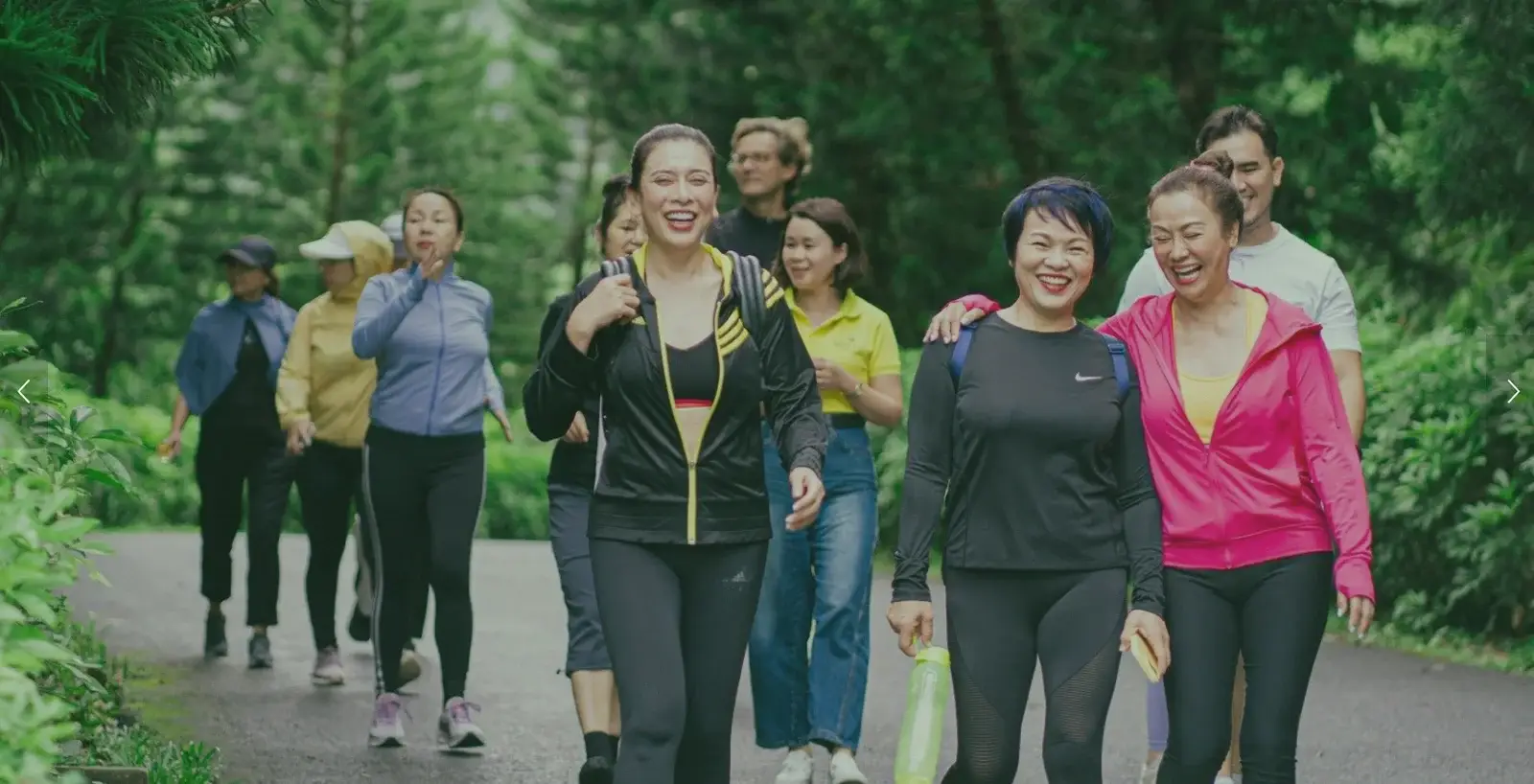 "An" Retreat @ Legacy Yen Tu MGalleryLegacy Yên Tử MGalleryMountain stillness, mindfulness and guided fasting in Yên TửNext retreat: 17–21 March 2027Discover →
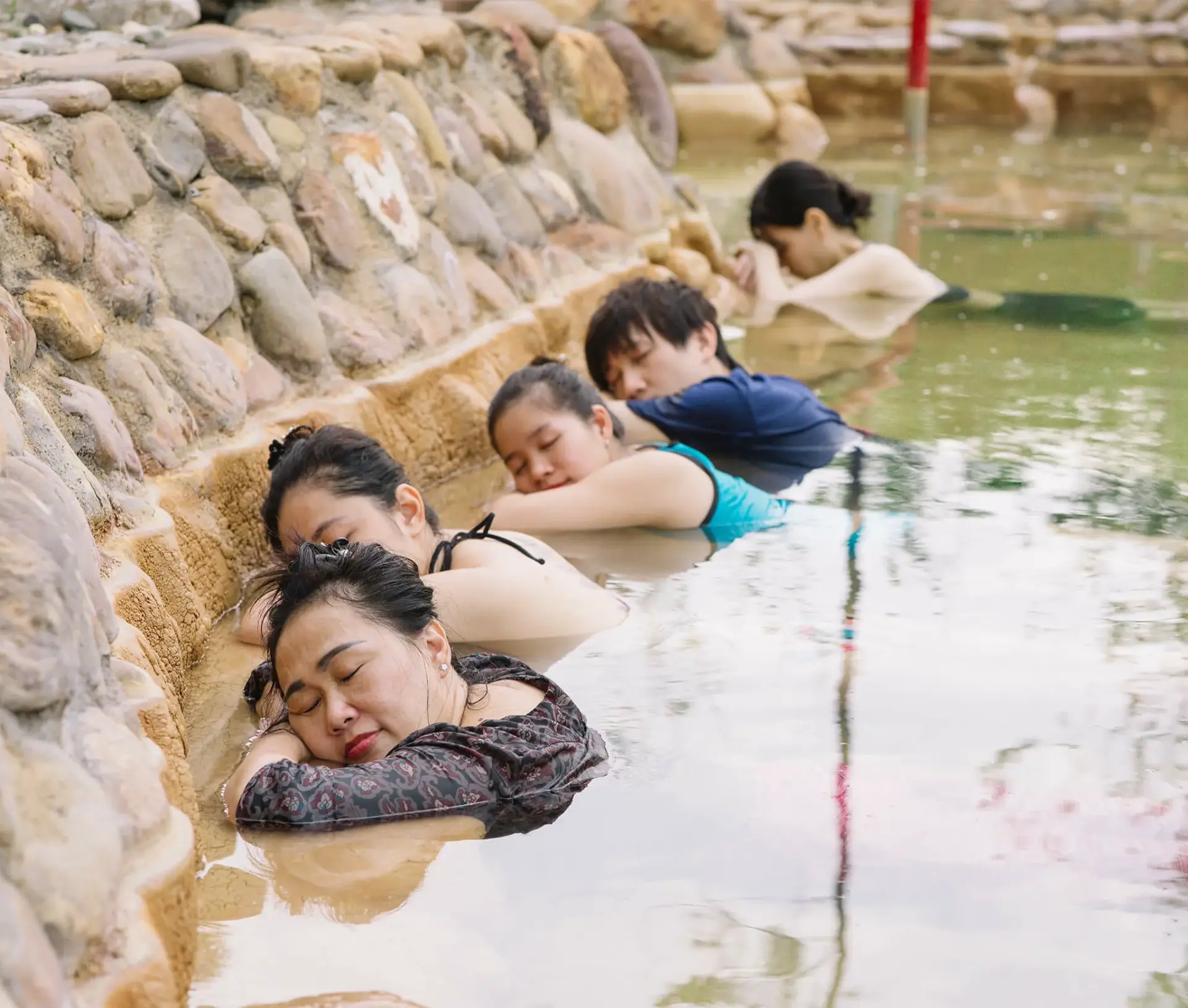 Yên RetreatAlba Wellness Valley, HuếNatural hot springs, herbal baths and deep restNext retreat: 16–20 December 2026Discover →
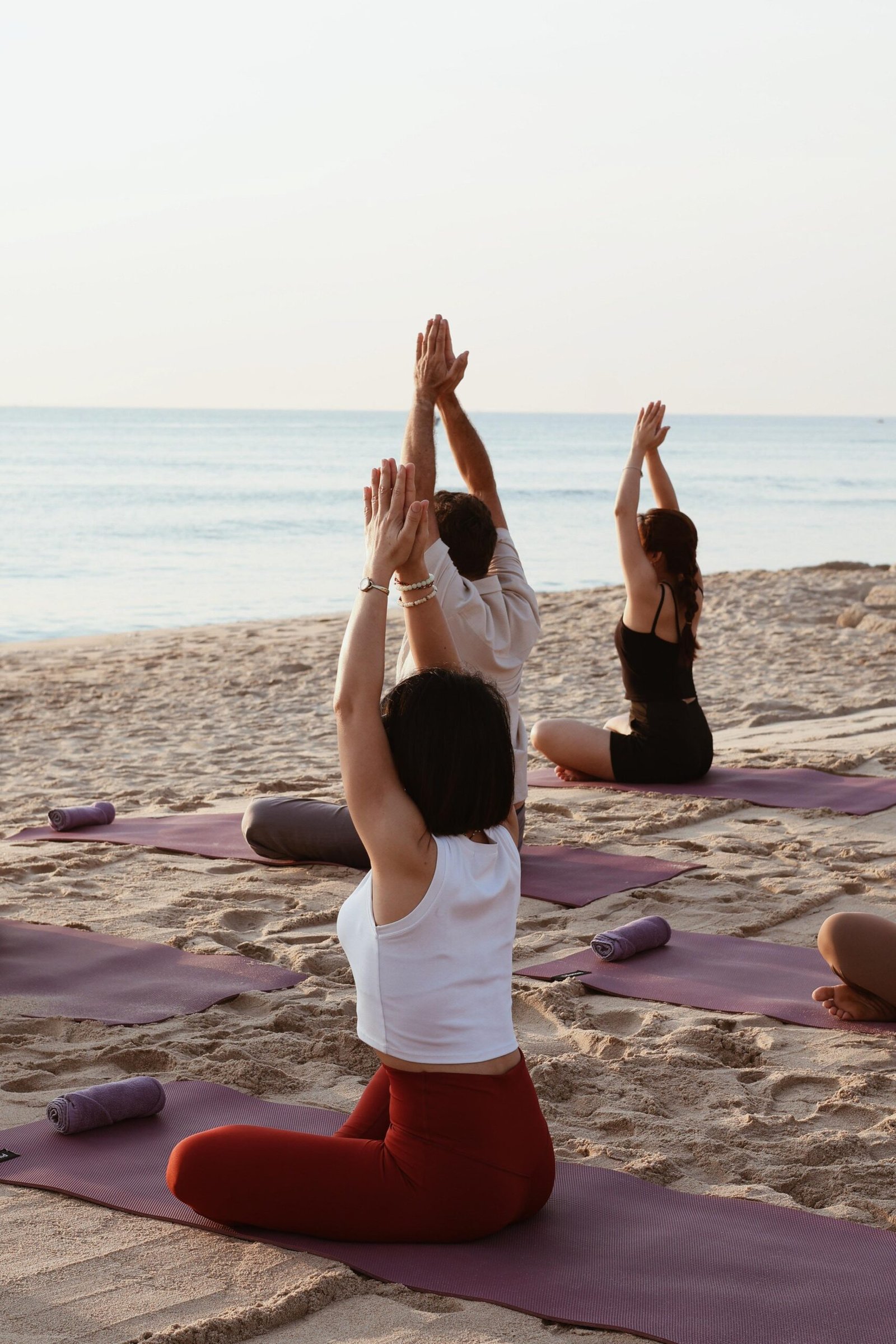 Hồi Retreat @ Fusion Resort & Villas Da NangFusion Resort & Villas Da NangSunrise beach walks, sea air and gentle fasting by the coastNext retreat: 20–24 January 2027Discover →