
Nutrition Journal
Many people in Vietnam look slim, wear the same jeans size as ten years ago and feel reasonably fit. Yet a scan can tell a different story. The fat that matters most for long-term health is often the fat you cannot see.
Visceral fat is the fat stored deep inside the belly, around the liver, stomach and intestines. You cannot pinch it, and the bathroom scale does not show it. Even so, research links it more closely with inflammation, diabetes and heart health than the number on the scale.
The good news is that visceral fat responds well to everyday habits. It is often among the first fat to shrink when you move more and eat a little differently. This article explains what it is, how to check it at home and which habits help most.
Your body stores fat in two main places. Most of it, more than 80 per cent, sits just under the skin. This subcutaneous fat is the soft layer you can pinch on your hips, thighs and belly.
Visceral fat lies deeper, inside the abdominal cavity. It hangs like an apron from the stomach (the omentum) and wraps around the intestines. Its blood flows straight to the liver, so the fatty acids and messenger substances it releases reach the liver first.

A third type, ectopic fat, builds up inside organs such as the liver and heart. Fatty liver is a common example, and it often rises together with visceral fat once the safe storage space under the skin is full.
Visceral fat is not a design fault. It is a quick-access energy reserve, and the omentum also contains immune cells that help to contain infections in the belly. Some researchers think that this protective role explains why humans store fat here at all.
Problems start when the store keeps growing. Several everyday factors push fat towards this deeper depot:
•Sugary drinks. In the US Framingham study, people who drank sugary drinks daily gained more visceral fat over six years than those who did not, even at the same weight change.
•Alcohol. In 5,761 adults in Oxford, more alcohol went with a larger share of fat stored around the organs.
•Short sleep. In a small 2022 Mayo Clinic trial, two weeks of four-hour nights increased belly fat, including visceral fat, in healthy young adults.
•Age and menopause. Visceral fat tends to rise with age. In women, it often increases after menopause, as oestrogen falls.
•Sitting and genes. Long hours of sitting add to it, and genes partly decide where each of us stores fat.
Compared with Europeans of the same weight, people of East and Southeast Asian heritage tend to store more fat around their organs. A large scan study of 4,504 people in 29 countries found that East Asians had the most visceral fat at a given BMI. Researchers sometimes call this pattern “thin outside, fat inside”.
Vietnam shows it clearly. In a CT study of 659 adults in Hồ Chí Minh City, very few people counted as obese by BMI. Yet almost half had a visceral fat area above the usual risk threshold of 100 cm².
Daily life in the cities adds to the picture. Vietnam now has about 77 million motorbikes, so short trips rarely happen on foot. According to WHO Viet Nam, people drank four times as many sugary drinks in 2023 as in 2009. Alcohol intake has also risen, and beer makes up most of it.

None of this calls for guilt. A cold beer with friends is part of life here. Still, it helps to know that a slim figure is not the whole story.
Visceral fat is not passive storage. It behaves more like an active organ, releasing fatty acids, hormones and inflammatory signals into the blood.
Journal: American Journal of Clinical Nutrition, 2026
Who was studied: 896 adults from two large US trials. Body fat was measured with a DXA scan, and hundreds of blood proteins were analysed.
What was found: Visceral fat showed the strongest inflammatory protein pattern of all the traits studied, ahead of blood pressure, blood fats, blood sugar and insulin resistance. Much of the link between those traits and inflammation disappeared once visceral fat was taken into account.
Limits: A snapshot at one point in time, so it shows a link, not cause and effect. Most participants were older Americans.
Meanwhile, larger studies point in the same direction. In UK Biobank, people with more visceral fat on MRI had a higher risk of coronary heart disease over 13 years, while fat under the skin showed no such link once waist size was considered. Visceral fat is also associated with type 2 diabetes and fatty liver, and research suggests links with some cancers and with dementia.
These are associations, not certainties. Many people with a larger waist stay healthy for decades. Rather than a cause for worry, see visceral fat as a useful signal, and one you can influence.
For everyday use, your waist and your height matter most, and both need only a tape measure.
Healthy ranges at a glance
| Measure | Healthy | Raised risk |
|---|---|---|
| Waist, Asian adults (Vietnam Ministry of Health) | Under 90 cm (men), under 80 cm (women) | 90 cm or more (men), 80 cm or more (women) |
| Waist, European adults (WHO) | Under 94 cm (men), under 80 cm (women) | 94 cm or more (men), 80 cm or more (women) |
| Waist-to-height ratio (NICE, all ethnicities) | Under 0.5 | 0.5 to 0.59 raised, 0.6 or more high |
| Skinfold above the hip bone (calliper) | No official range; lean young adults average about 14 to 15 mm | Around 30 mm or more |
| Visceral fat area on CT or MRI | Under 100 cm² | 100 cm² or more |
| Home scale “visceral fat level” | Depends on the brand: Fitdays under 10, Tanita 1 to 12, Omron 1 to 9 | Fitdays 10 or more, Tanita 13 or more, Omron 10 or more |
A simple rule comes from the UK health guideline body NICE: keep your waist to less than half your height. At 160 cm tall, that means a waist below 80 cm. Vietnam’s obesity guideline sets a lower limit for men than Europe does, because Asian adults tend to face higher risks at a smaller size.
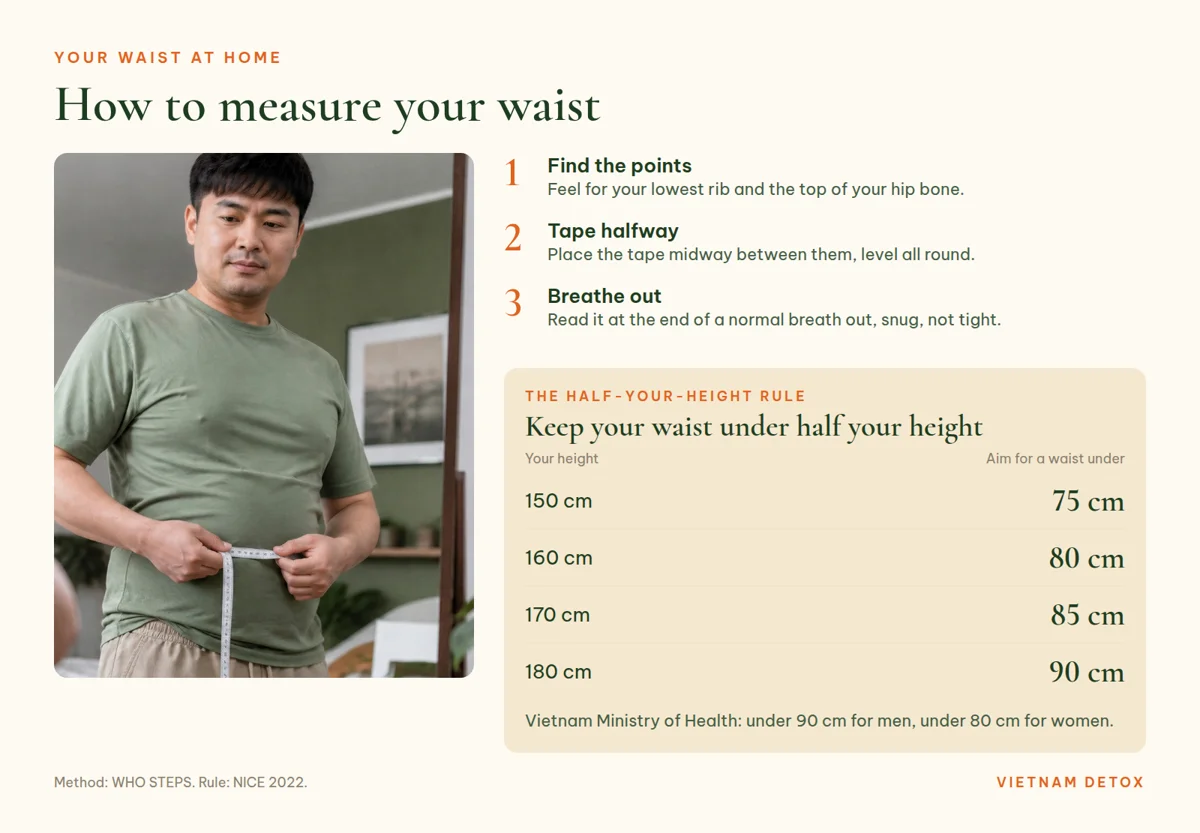
Stand relaxed with your feet together. Find the lowest rib and the top of your hip bone, and place the tape halfway between them. Keep it level all round, snug but not tight. Then read it at the end of a normal breath out. This is the method the WHO uses in its surveys.
After that, measure at the same time of day, ideally in the morning before breakfast. Once a month is enough to see a trend.
At our check-ups we also measure a skinfold just above the hip bone with a calliper. Strictly speaking, it measures the fat under the skin, not visceral fat. Still, belly skinfolds tend to rise and fall with the fat inside, so the pinch adds a useful second view to your waist.
There is no official healthy range, but research offers guide values. In an Italian study of 720 young adults, this fold averaged about 14 mm in men and 15 mm in women. Professional footballers measured 7 to 10 mm. In a 2022 study of Asian Indian adults, readings of around 30 mm or more went with a cluster of metabolic risks, such as higher blood sugar and blood fats.
The lowest reading we have ever taken was 4 mm, in a very active 48-year-old guest from Da Nang. Because results depend on the hand holding the calliper, the same person, side and spot matter more than any single number.
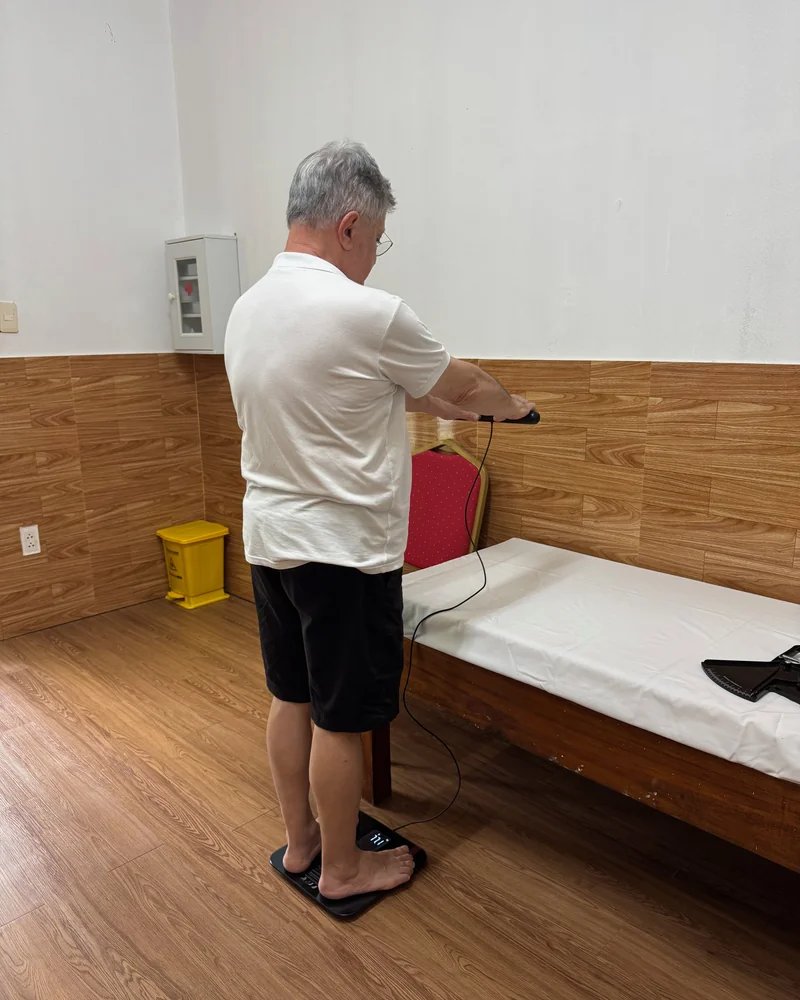
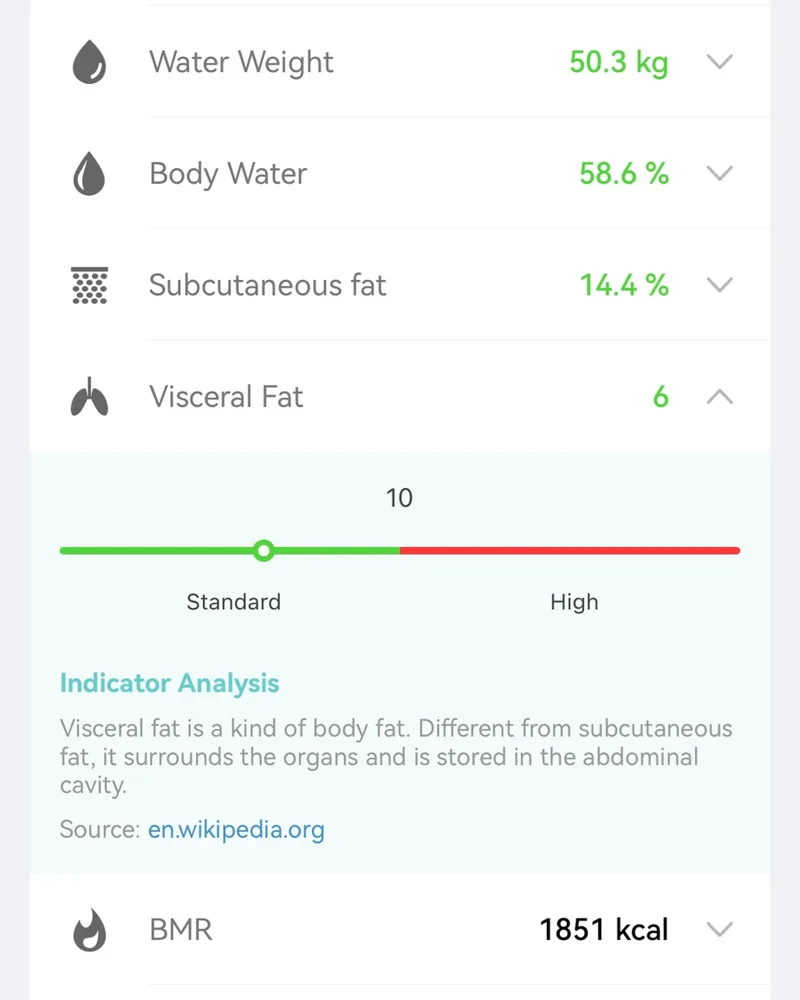
Body-composition scales send a tiny, harmless current through your body. They measure how easily it flows, then estimate visceral fat with a formula that also uses your weight, height, age and sex. The scale does not see visceral fat directly.
These readings are therefore approximate. In a study of 414 adults in China, bioimpedance agreed only poorly with CT scans. Even clinic devices with hand and foot sensors can be off by tens of square centimetres for one person. Scales are most useful for following your own trend over weeks, on the same device and under the same conditions.
Movement is the clearest lever. Brisk walking, where you can talk but not sing, already counts. Many Vietnamese parks fill with walkers, dancers and tai chi groups from five in the morning, and joining in is one of the simplest habits you could start.

Strength training also helps, especially for keeping muscle as you age. On its own, however, it reduces visceral fat less than aerobic exercise does.
At the table, the evidence favours whole foods: vegetables, beans, tofu, fish and herbs, with fewer sugary drinks and less alcohol. In other words, a traditional Vietnamese family meal is a good starting point. Our article on eating vegetables first and rice last shows how to make it even gentler on blood sugar.


Finally, sleep is the quiet partner. Seven to eight hours supports appetite control and, as the Mayo Clinic trial suggests, helps keep fat away from the belly.
Fasting and visceral fat are closely connected. When food intake pauses, the body turns to its fat stores, and visceral fat is easy to mobilise.
In a study of 1,422 people who fasted with the Buchinger method, waist size fell by an average of 4.6 cm after five days. A 2026 MRI study of a 12-day Buchinger fast measured visceral fat directly. It was about 9 per cent lower at the end of the fast and about 16 per cent lower four months later, with the clearest changes in people over 50.
To be fair, both studies had no comparison group, and researchers linked to a Buchinger clinic were involved. Intermittent fasting, such as eating within an eight-hour window, also reduces visceral fat, though not clearly more than simply eating less. In practice, the approach you can keep up matters most.
Prescription weight-loss injections also reduce visceral fat. They are a decision for you and your doctor and lie outside the scope of a wellness retreat.

At every retreat, our wellness check-up includes your waist, the skinfold above the hip bone and a body-composition scale with hand and foot sensors. We measure on arrival and again before you leave. Most guests see their visceral fat estimate fall by one level or more over the five days.
We see this as encouragement, not proof. The real value lies in what follows: daily walks, nourishing building-up days and habits you can take home. Our article on the building-up days explains how the retreat continues in your own kitchen.
Why the number can sometimes go up
Occasionally, a guest’s visceral fat level is a little higher at the end of a fast. This does not mean fat has been gained. During fasting, the body quickly loses water, stored carbohydrate and salt, and that changes the electrical reading the scale relies on. A different time of day, the hot springs or a warm bath can shift it too. One level up or down is within the normal margin of these devices. That is why we also look at your waist and skinfold, which do not depend on body water in the same way. At home, check again on the same scale, at the same time of day, two to four weeks later.
Our tip
You could start with one week and one tape measure:
•Measure your waist this week and note it next to your height. Is it under half?
•Add 30 minutes of brisk walking on most days. A morning lap of the park or an evening walk after dinner both count.
•Swap one sugary drink a day for water, green tea or unsweetened iced tea.
•Keep beer for occasions, rather than for every evening.
•Protect your sleep with a regular bedtime, even on weekends.
Then measure again in a month. A smaller waist is a lovely, very real sign of progress.
Signs worth discussing with a doctor
•A waist above 90 cm (men) or 80 cm (women), or above half your height, especially with a family history of diabetes or heart disease
•Strong thirst, frequent urination or unexplained tiredness
•A fatty liver noted on an ultrasound, even if you feel well
•Plans to fast if you take medicines for blood sugar or blood pressure, are pregnant or have a long-term condition
Share this article
Questions about visceral fat or our check-ups? We would be glad to hear from you. Write to us.
With warm wishes,
Dieter and the Vietnam Detox team
Next step
Our preventive wellness retreats combine Buchinger fasting, daily walks, careful building-up days and time in nature.
 "An" Retreat @ Legacy Yen Tu MGalleryLegacy Yên Tử MGalleryMountain stillness, mindfulness and guided fasting in Yên TửNext retreat: 17–21 March 2027Discover →
 Yên RetreatAlba Wellness Valley, HuếNatural hot springs, herbal baths and deep restNext retreat: 16–20 December 2026Discover →
 Hồi Retreat @ Fusion Resort & Villas Da NangFusion Resort & Villas Da NangSunrise beach walks, sea air and gentle fasting by the coastNext retreat: 20–24 January 2027Discover →